Break The Circle
Real Talk for Men Who Are Done Running
Young Man From Abuja Reveals a Simple 30-Day Brain Rewiring Method That Helps Nigerian Men Finally Break Free From Their Most Shameful Private Habit — Without Willpower, Therapy, or Anyone Ever Finding Out

You know that feeling.
You told yourself last time was the last time.
You deleted the apps. You changed your password. You even moved your phone charger to another room so you wouldn't be on your phone late at night.
And for a while — it worked.
Maybe two weeks. Maybe three. Maybe you even hit a whole month and started to feel like you were finally done with this thing.
Then one evening — nothing special about it — you're just lying there, a little bored, a little tired from the day...
And before you even make a conscious decision, you're already halfway through.
And when it's over, you don't even feel anything.
Just that familiar silence. That hollow, disgusting silence.
You close the tab fast. You sit there for a moment. Maybe you wash your hands. Maybe you stare at yourself in the mirror and think — why. Why again. What is wrong with me.
Then you make the promise again. The same promise.
"That was the last time. I swear. Starting tomorrow, I'm done."
But you've said those exact words before. Many times. And here you are again.
And the worst part? It's not even enjoyable anymore. It stopped being enjoyable a long time ago. Now it's just... automatic. Like your brain found a shortcut and won't stop taking it — no matter how many times you block the road.
You pray. You fast. You've read the articles. You've watched the YouTube videos. You've told yourself every version of every motivational speech a man can give himself at 2am.
And none of it has stuck.
So you carry it. Quietly. Underneath every conversation, every prayer, every moment where you're laughing with your guys but something inside you feels... fake. Like there's a version of you that nobody knows about. A version you're ashamed of. A version you've been fighting for years and keep losing to.
You wonder sometimes if you'll ever actually be free. Or if this is just something you're going to manage for the rest of your life — giving in and repenting, giving in and repenting, until you die.
Stop everything right now and read every single word I'm about to say.
Because what I'm going to share with you today changed everything for me — and I believe it will change everything for you too.
"Because I'm about to share with you a simple 30-day brain rewiring method that ended the secret compulsive cycle for me permanently — and is now doing the same for hundreds of men just like you."
This method didn't come from a therapist's office. It didn't come from a self-help book or a YouTube channel or a motivational coach who has never actually lived inside this struggle.
It came from a conversation I wasn't supposed to have — with a man I wasn't supposed to meet — on a day when I had completely given up.
The knowledge behind this method is rooted in something our fathers and grandfathers understood about the male mind that modern society has completely forgotten. They didn't have smartphones or the internet — but they understood discipline, identity, and how to train a man's mind at its deepest level. This method draws from that ancestral understanding and combines it with what modern behavioural science now confirms actually works.
My name is Ayo.
The first thing you should know about me is that I am not a therapist. Not a counsellor. Not a life coach or a religious scholar. I'm just a regular 27-year-old man from Abuja who spent years trapped in the exact same cycle you're in right now — and who found a way out that nobody ever taught me. I packaged everything I learned into a simple guide because I got tired of watching other men suffer through what I already survived alone.

Let me tell you exactly how this started for me.
I was 17 the first time I stumbled onto harmful screen content online. I wasn't looking for it. A friend sent a link in a secondary school WhatsApp group and — you know how these things go — curiosity did the rest.
At first it felt like nothing serious. Just something I did occasionally. "It's normal," I told myself. "Every guy does this."
But by the time I was 20, it wasn't occasional anymore.
It had become a daily thing. Sometimes twice a day. A routine that I didn't even consciously choose — my brain just went there automatically whenever I was bored, stressed, lonely, or tired. Which, as a young man in Abuja trying to find his feet, was almost always.
The shame was quiet at first. Background noise. Easy to ignore when life is busy.
But it got louder.
I started noticing it was affecting how I talked to people. I became withdrawn. Less confident. In conversations with people I respected — especially women — there was always this secret underneath everything. This thing I was hiding. And when you're hiding something that heavy, it leaks. It comes out as awkwardness. As avoided eye contact. As a man who doesn't fully show up anywhere because part of him is always somewhere else.
My faith suffered the most.
I would pray, then go back to the habit. Ask God for forgiveness, feel clean for a few days, then fall back again. The cycle became so predictable that I started feeling like my repentance was a lie. Like I was performing sincerity without actually having any. What kind of man begs for forgiveness knowing he'll do the same thing again in two weeks?
That question destroyed me quietly for years.
My breaking point came on a Thursday evening in 2023.
I had just fallen back into the habit for the third time that week. I sat on the edge of my bed, phone face down on the floor, and I just — broke. Not dramatically. Not crying. Just this quiet, total collapse of something inside me. Like a structure that had been cracking for years finally giving way.
I remember calling my older cousin. Not to tell him what was happening — I would never do that. Just to hear a voice. He said something I've never forgotten:
"Ayo, the problem with our generation is that we fight wars we don't understand. You can't win a battle if you don't know what you're actually fighting."
He meant something else entirely. But those words stayed with me.
The Solutions I Tried That Failed
1. Deleting all the apps and blocking websites. This worked for maybe two weeks. Then I found workarounds. VPNs. Incognito mode. A browser I'd never used before. My brain was more creative at finding the content than I was at blocking it. The compulsive urge didn't disappear — it just got smarter.
2. Increasing my spiritual practice. Spiritual practice alone, without addressing the neurological rewiring that compulsive habits create, is like trying to put out a fire with prayer while someone is still pouring fuel on it. The spirit was willing. The brain's pathways were still fully intact.
3. Keeping myself busy from morning to night. This helped during the day. But busyness runs out. Night comes. The apartment gets quiet. Your roommate is asleep. And suddenly all that busy-ness disappears and you're alone with a phone and a brain that has been waiting all day for this moment.
4. Cold showers. The shock of cold water kills the urge — for about four minutes. Then you're standing there, wet and cold, and the urge is still there waiting politely for you to finish your shower.
5. Accountability partners. I tried this with a friend. It lasted one week before we both got too embarrassed to be honest. Nobody wants to tell another man that they fell back into the habit. So we both lied. And eventually stopped checking in at all.
6. Online self-discipline challenges and communities. The motivation was real. The community support was real. But after the motivation wave passed — usually around Day 10 or 14 — I had no system to fall back on. Motivation without a system is just delayed failure.
I was exhausted.
It was after Friday prayers at the National Mosque in Abuja — a day I almost didn't go because I had fallen back into the habit the night before and felt too ashamed to stand in that space. But I went anyway. Because staying home felt worse.
As people were filing out, I found a quiet corner of the mosque courtyard and just sat there. Not praying. Not doing anything. Just sitting with the weight of it all.
An older man sat down nearby. He looked to be in his late 50s — well-dressed, calm, the kind of man who moves like he has nothing to prove to anyone. We exchanged greetings. He asked if I was okay. Something about the way he asked made it feel like a real question, not a formality.
I don't know why I answered honestly. Maybe I was just tired of carrying it alone. Maybe the mosque felt like the one place I could say a true thing without it being used against me.
I told him I was struggling with a compulsive habit I couldn't stop. I didn't name it directly. But the way I said it — he understood.
He was quiet for a moment. Then he said something that stopped me completely:
"Brother, every man I have ever met who is fighting what you are fighting is fighting it the wrong way. They are fighting the desire. You cannot win that fight. The desire is not the enemy — the pathway is. You don't fight the road. You build a different road."
I stared at him.
"The brain is a habit machine," he continued. "It does not care whether the habit is good or bad. It only cares whether the habit is familiar. What you have done over years is make one pathway so familiar that your brain takes it automatically — without asking your permission. The solution is not to block that pathway with willpower. Willpower is a muscle that gets tired. The solution is to build new pathways so strong, so consistent, and so rewarding that the old pathway becomes unfamiliar. An unused road becomes overgrown. That is how you win."
He outlined — in that quiet mosque courtyard in Abuja, in about twenty minutes — the exact framework that I later spent months refining, testing, and documenting into a complete system.
I'll be honest. My first reaction was scepticism.
It can't be this simple, I thought. I've been suffering for years and this man is describing habit loops and brain pathways like it's just a matter of following some steps?
But I had tried everything else. So I tried this.
The first few days — nothing. The urges were still there. The familiar pull at familiar times. I followed the method anyway. The trigger audit. The interrupt system. The morning routine. All of it, exactly as he described.
By Day 9, something shifted.
The compulsive urge arrived — like it always did, around 10pm — but instead of the usual overwhelming wave, it felt... smaller. Like a knock on a door instead of someone trying to break it down. I used the interrupt technique. The urge peaked and then — it passed. On its own. Without me white-knuckling through it. Without me running to another room or calling someone or splashing cold water on my face. It just... passed.
I sat there for a full minute just to make sure I wasn't imagining it.
By Day 21, the shift was undeniable.
My roommate Emeka — who knew nothing about any of this — looked at me one morning over breakfast and said, "Ayo, you've been different lately. What happened? You seem more... settled."
I just smiled. "I started a new routine," I told him. Which was completely true.
By Day 30, I felt like a different man. Not perfect. Not superhuman. But in control in a way I hadn't felt since I was 16 years old.
The confidence wasn't from the streak. It was from finally knowing — deep in my bones — that I was the one in charge of my mind. Not the other way around.
I shared the framework quietly with three other guys. Within six weeks, all three reported the same shift. Damilola from Lagos sent me a voice note on Day 24 that I still have saved: "Bro. I think it's actually working. I don't understand how it's this quiet now but it's quiet."
Kenny from Port Harcourt had tried self-discipline challenges seven times over three years and never made it past Day 14. He completed the 30-day method. Then did it again. He's now on a streak he doesn't even count anymore because the compulsive urge no longer feels like a threat.
That was when I knew I had to package this properly.
I kept getting messages from men in Abuja, Lagos, Kano, London, Houston — wanting to know what I was doing. I couldn't reply individually anymore. There wasn't enough time. And some of these conversations were too private to have one-by-one over chat.
So I wrote it all down.
Every step. Every technique. Every tool. The science behind why it works. The spiritual framework that holds it all together regardless of your religion. The daily tracker. The urge emergency card. The recovery protocol for the days when things don't go perfectly — because real life is not a motivational video and men need a system that survives bad days, not just good ones.
I put everything into one simple guide.
Introducing...
Introducing
The Hidden Urge Silencer
A Simple 30-Day Brain Rewiring Method That Breaks the Compulsive Cycle Most Men Carry Alone
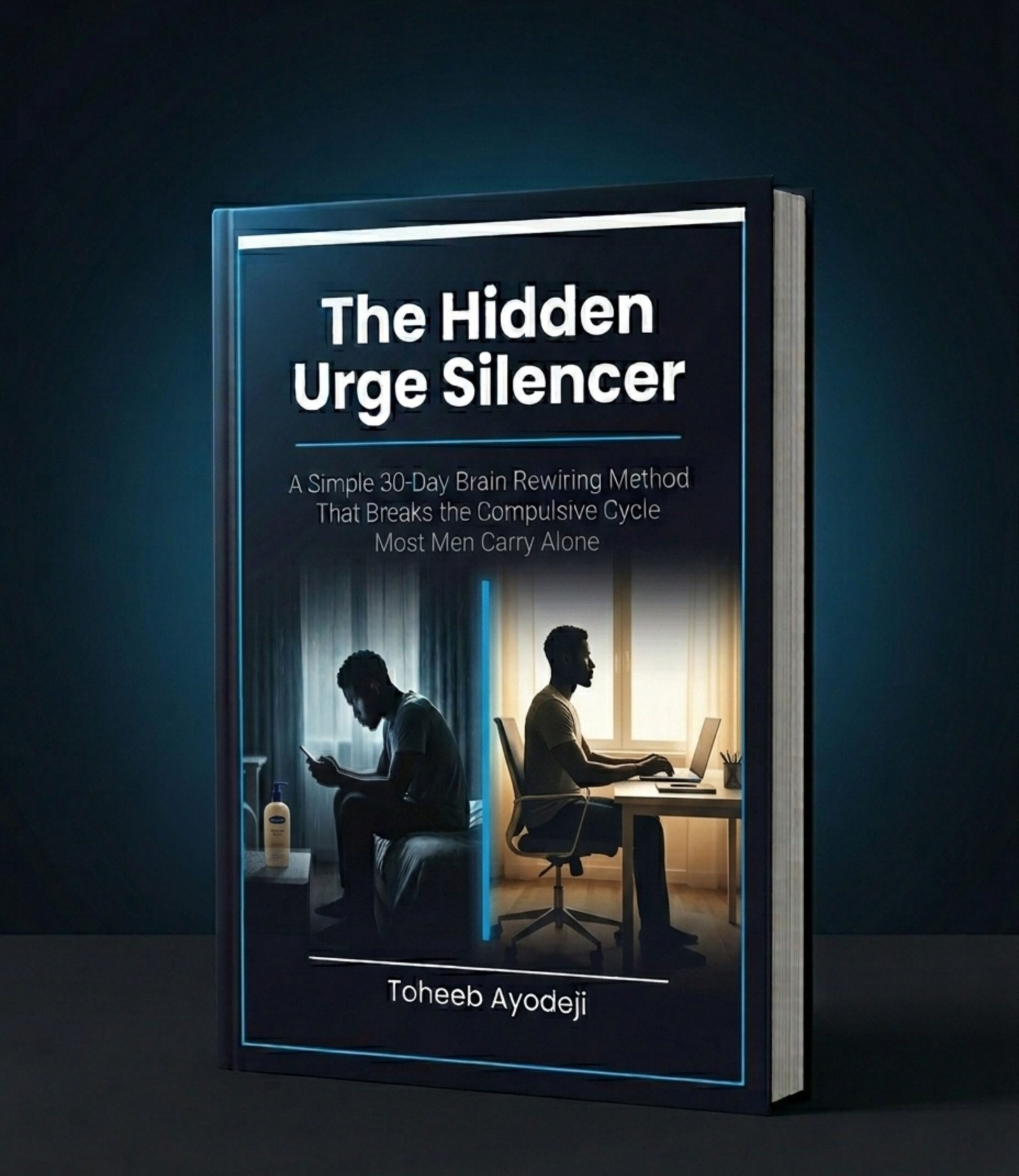
Inside this e-guide, you'll discover:
- The Personal Trigger Audit — Pg. 6 — A one-page exercise that maps your unique compulsive pattern and identifies your exact high-risk trigger situations. Most men have never done this. Once you see your own pattern written down in front of you, the cycle stops feeling random and starts feeling stoppable.
- The Dopamine Pathway Explained in Plain English — Pg. 11 — Why your brain keeps going back even when you desperately don't want it to. This single chapter will permanently change how you understand your own mind — and why willpower was never going to be enough on its own.
- The Trigger Interrupt System — Pg. 15 — A set of specific, field-tested techniques to deploy the moment a compulsive urge arrives — before it builds into a craving you can't resist. These take less than 2 minutes and work even when you're half-asleep at 11pm.
- The Universal Morning Anchor Routine — Pg. 23 — "Whatever your religion — use your morning prayers as your first line of defence." A structured daily routine designed for your most vulnerable times. Works for Muslim men, Christian men, and every man in between.
- The 30-Day Daily Tracker — Pg. 28 — A simple day-by-day checklist you mark off each morning. Visual momentum is one of the most powerful psychological tools available. When you see a streak building in front of you, your brain protects it automatically.
- The Identity Shift Framework — Pg. 33 — The difference between men who fall back after 30 days and men who never go back is not willpower — it is identity. This section shows you how to make the permanent shift from "I am trying to quit" to "I am someone who does not do this."
- The Recovery Protocol — Pg. 38 — A compassionate step-by-step guide for what to do within 24 hours of a slip. Because real life is not perfect, and a system that only works on good days will fail you. This ensures one bad moment never becomes a week-long collapse again.
And the best part? You don't need a therapist, you don't need to tell anyone, and you don't need to have tried and failed before this works. It's the same simple method that worked for me and has now worked for over 200+ men across Nigeria, Ghana, Kenya, the UK, and the US.
Real Men. Real Results.
Bros, I no go lie — I don buy plenty things wey no work before. When I see this one I say make I just try am. Day 11 I start feel am. By Day 20 the urge wey dey always come every night just... stop like that. I no understand am fully but e dey work. If you dey struggle with this thing, abeg just buy am. Wetin you get to lose?
I have been fighting this since university. That is 6 years. I tried self-discipline challenges three times and never passed Day 12. This method is different because it doesn't just tell you to be strong — it tells you exactly what to do in the exact moment the urge hits. The Urge Emergency Card alone was worth the price. I'm on Day 28 right now and I feel genuinely different inside.
What I appreciated most is that this guide doesn't make you feel like a bad person. The first chapter — the trigger audit — I did it and I actually understood why I kept going back. Nobody had ever explained it that way to me. Once you understand why, the how becomes much easier. I've recommended this to two of my closest friends already.
As a Muslim man, I appreciated that this guide respects my faith without making the whole thing about religion. The morning anchor routine works perfectly with Fajr. By Day 15 I noticed my concentration in salah improved as well — I think because the shame that used to sit underneath everything started to lift. This is a serious guide for serious men.
I completed the 30 days. I want to say that clearly because I have never completed anything like this before. Seven attempts at self-discipline challenges, four different apps, two accountability partners — all failed. This method has a different structure. The recovery section especially — knowing that one slip doesn't reset everything removes the shame spiral that used to send me back into the cycle for weeks.
Just So You Know... Putting This Guide Together Cost Me Over N220,000
Before you see the price, I want you to understand what went into this.
- Professional copywriter and content editor to structure the 30-day method clearly — N60,000
- Behavioural psychology research and consultation to validate the science — N28,000
- PDF design and layout — professional formatting, diagrams, tracker design — N22,000
- Beta testing with 12 men over 30 days and refining the method based on real results — N18,000
- Website, hosting, and digital delivery setup — N100,000
Total investment: N228,000+
I'm sharing this so you understand that what you are getting is not a rushed PDF thrown together in a weekend. This is a tested, refined, professionally structured system that cost real money to build properly.
I'm not going to charge you N228,000...
I won't even charge you N100,000...
Not even N50,000...
I won't even charge you the original fair price of N20,000...
⚠️ This Discounted Offer is ONLY For the First 20 People — Hurry!
Once the timer hits zero, the price returns to N20,000. Don't wait.
Secure payment. Instant digital delivery. 30-day money-back guarantee.
WAIT! I Have a FREE Gift For You...
If you're among the first 20 people paying right now, you'll get these two powerful bonuses alongside your guide. TODAY ONLY.
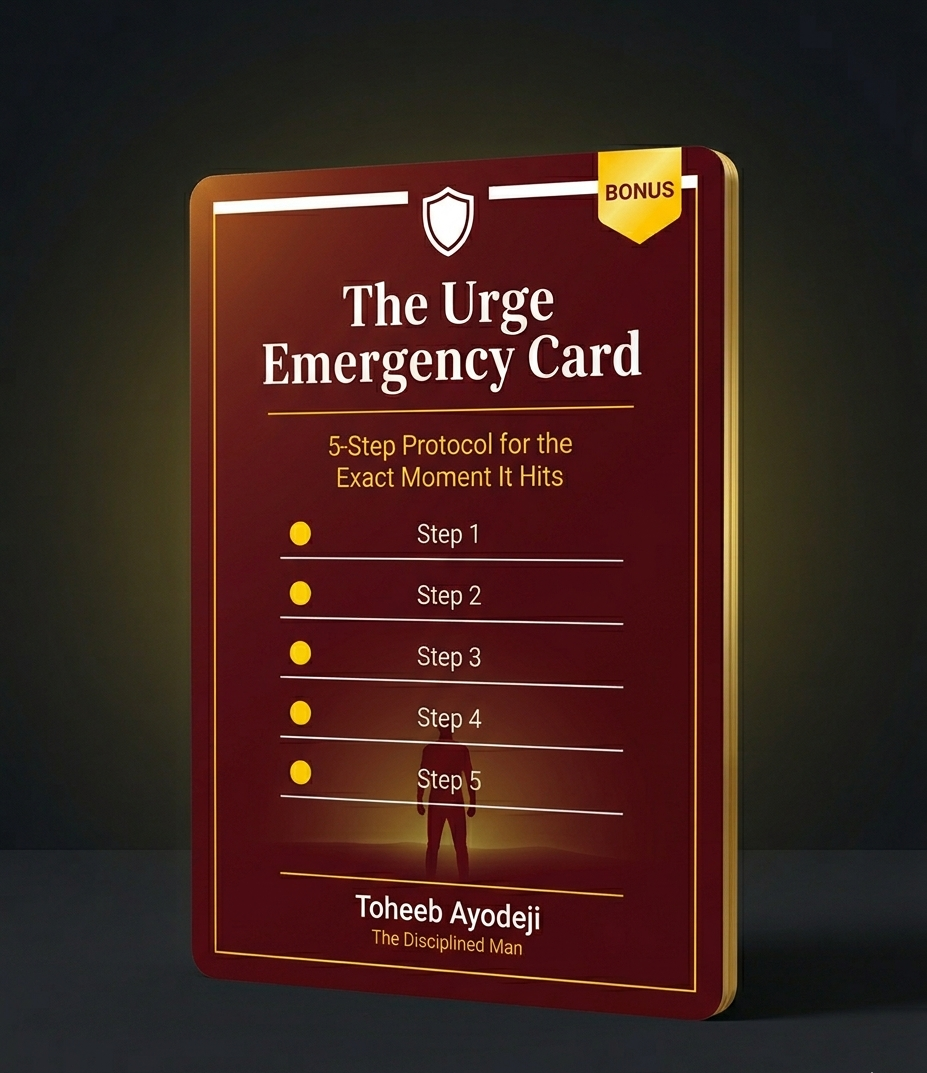
The Urge Emergency Card
A printable one-page quick-response guide for the exact moment a compulsive urge hits. Save it to your phone. When the moment comes — open this card and follow the 5-step sequence. By step 5, the urge will have passed. This card alone has helped hundreds of men stay in control at their most vulnerable moment.
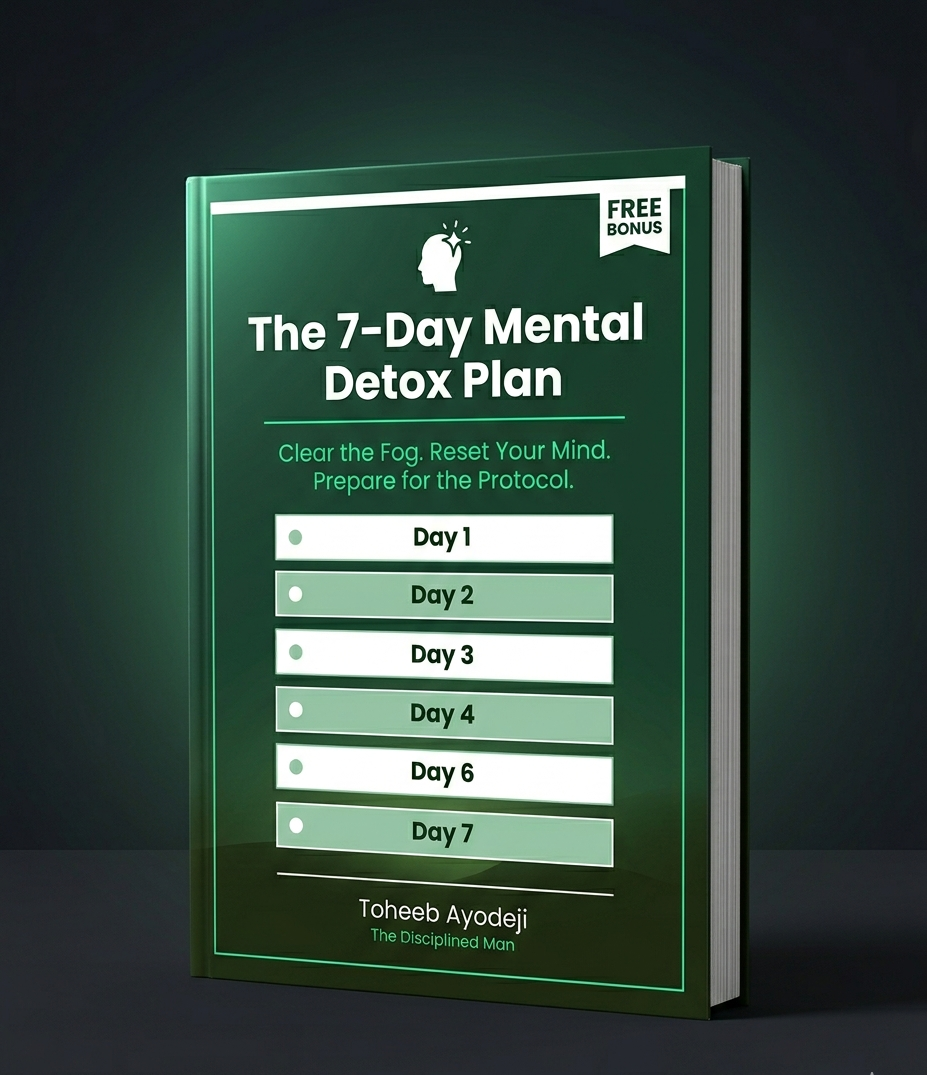
The 7-Day Mental Detox Plan
A one-week starter plan to begin clearing the mental fog before the full 30-day method begins. Think of this as the warm-up. It prepares your mind, establishes your morning routine, and sets the foundation so that when Day 1 of The Hidden Urge Silencer begins, you're already in the right mental state to go all the way.
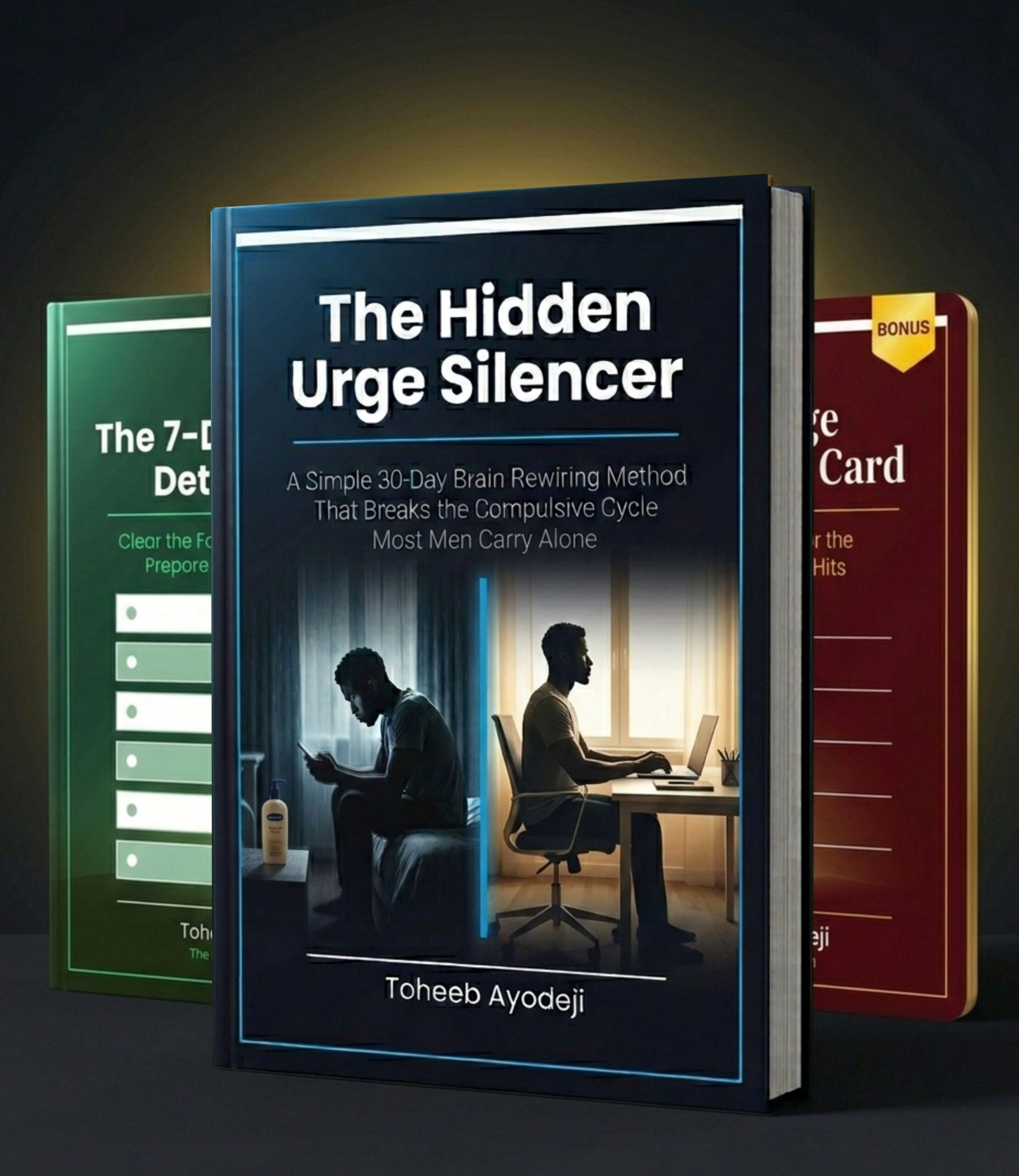
First 20 people only. Price returns to N20,000 after.
See What's Happening Right Now
Real payments coming in from men who decided to take action.
14 people have already taken advantage of this discount...
Only 6 spots remain at the N9,500 price.
Bear in mind — you are not the only one viewing this page right now.
Price returns to N20,000 once the 20 spots are gone.
My Personal 30-Day Money-Back Guarantee
Still feeling unsure? I completely understand. You've spent money on things before that didn't work. I know that feeling personally.
Which is why I'm making you a bold, risk-free promise:
Download The Hidden Urge Silencer today. Follow the full 30-day system. Use the tools daily. If after genuinely completing the method you don't feel a shift — send me a message with proof of your effort within 30 days and I will refund every single naira. No runaround. No games. Just results — or your money back.
You either get the results or you get your money back. That's my guarantee to you as a man who has been exactly where you are standing right now.
The only way you lose is by not trying.
Fully protected by 30-day money-back guarantee.
More Men. More Results.
The section on the identity shift on page 33 changed something in me I can't fully explain. I've been trying to break this cycle for 4 years. What this guide helped me understand is that I was trying to quit as someone who had the problem. I needed to become someone who doesn't have the problem. That sounds small but it's not. I'm on Day 32 now.
Wallahi, I tried to break this habit for my marriage. My wife doesn't know about this and I wanted to come into our marriage clean. I tried twice on my own and failed. A brother in my masjid told me about this method quietly. I completed the 30 days two weeks before my wedding. That was the gift I gave myself. I'm grateful.
I was sceptical because I've been disappointed before. But the price was low enough that I said — what do I have to lose? The trigger audit on the first pages was a revelation. I saw my own pattern clearly for the first time. The late night boredom. The stress after work. Once I could name it I could interrupt it. I'm 19 days clean. Keep going brothers.
E no easy but this thing dey work. The daily tracker be the one wey help me pass. Every morning wey I tick that box, I no wan lose the streak. By Day 14 I start dey protect am like say na money. My focus for work improve. My prayer improve. Even my sleep improve. Buy am abeg, you go thank yourself.
The recovery protocol saved me on Day 17. I slipped. And in the past that slip would have sent me into a dark place for a week. Instead I opened the recovery protocol, followed the steps, and was back on track within 24 hours. That single section is worth more than the entire price of the guide. This is built by someone who truly understands.
You Have Two Options Right Now
✅ Option 1 — Take Action
Get The Hidden Urge Silencer today for just N9,500. Start the 30-day system. Use the tools. Follow the method. And finally — after all these years — become the man you've been trying to be. Clean. Focused. In control. Worthy of the life you're building.
✗ Option 2 — Close This Page
Go back to doing what you've been doing. Deleting the apps. Making the promise. Going back to the habit. Repeating. Carrying the shame quietly underneath everything. Hoping that willpower will eventually be enough — even though it hasn't been for years. Maybe next month. Maybe next year. Maybe never.
You didn't stumble onto this page by accident. You've been carrying this for a long time. And something — call it what you want — led you here today.
The timer is running. The 20 spots are filling. And the only question left is whether today is the day you decide enough is enough.
Once the timer hits zero, the price returns to N20,000. Don't wait.
N9,500 only. Instant delivery. 30-day money-back guarantee. First 20 people only.
Disclaimer: Results vary by individual. The Hidden Urge Silencer is a digital self-help guide based on behavioural psychology principles and personal experience. It is not a substitute for professional medical or psychological therapy. If you are experiencing severe mental health challenges, please consult a qualified professional.
Share Your Experience